"I think we've designed a Class A or A+ apartment building."
That's how Pablo Reiter described the project his firm, Blue Wave Developers, is planning for an entire city block on Maury Street in Manchester. It's a fair description. It's also the whole story, in one sentence, for anyone trying to buy rather than rent in Richmond's two most talked-about neighborhoods right now.
If you've been watching Manchester and Scott's Addition from the sidelines, waiting for the construction boom to translate into more houses on the market, the wait has been longer than the headlines suggested. Search either neighborhood today and you'll find a startlingly short list of homes for sale, sitting next to a very long list of cranes.
The Listings Don't Match the Headlines
As of late August 2026, active for-sale listings across all of Manchester number in the high twenties. Scott's Addition, despite being described by its own boosters as Richmond's premier live-work-play district, had just 13 condos on the market as of this same week, at a median list price of $478,000.
Meanwhile, the construction pipeline in both neighborhoods is enormous. Manchester alone saw three apartment projects break ground in a single stretch of early 2026, adding roughly 400 units to the neighborhood. Avery Hall Investments is building a two-tower riverfront complex, 16 and 17 stories, linked by a shared parking deck and slated for completion in 2027. When finished, it will be the tallest new residential construction Richmond has seen in years. None of those units will ever appear in a for-sale search.
Scott's Addition's marquee 2026 project is a $144 million, 400,000-square-foot mixed-use building at 3200 W. Moore Street, a joint venture between Hoffman & Associates and DeBartolo Development that broke ground in March. Hoffman's other Richmond claim to fame is The Wharf, the mixed-use riverfront development in Washington, D.C. built almost entirely around apartments, retail, and hotel rooms. The neighborhood has also approved two new hotels, a 253-room Shamin Hotels project near Arthur Ashe Boulevard and a second hotel planned for Roseneath Road and West Moore Street projected to generate roughly $20 million in revenue over 20 years.
Put those two facts side by side and the mismatch is the story. Hundreds of new addresses are being built. Almost none of them come with a deed you can put your own name on.
What's Under Construction vs. What You Can Actually Buy
| Neighborhood | Under construction (2026) | For sale right now |
|---|---|---|
| Manchester | 400+ apartment units across three projects that broke ground in early 2026, plus Avery Hall's twin 16- and 17-story rental towers targeted for 2027 | Roughly 28 total active listings, per Zillow's live count in late August 2026, spread across lofts, rowhouses, and a handful of small conversion units |
| Scott's Addition | A $144 million, 400,000-sq-ft mixed-use rental project at 3200 W. Moore St., plus two approved hotels totaling several hundred rooms | 13 condos for sale, per Redfin's late-August count, at a median list price of $478,000 |
Why Developers Are Building Apartments and Hotels, Not Houses
This isn't an accident of timing. It's what the numbers tell a developer to do right now. Gross rental yields on condos in Scott's Addition and Manchester run 5% to 6.5%, and single-family rentals in comparable Richmond neighborhoods run 6% to 8%, figures that compare favorably to Northern Virginia's 3% to 4.5% range. For a developer weighing a 200-unit apartment building against a 20-unit condo building on the same parcel, the rental math wins, especially with lease-up measured in months rather than the longer sales cycle a condo building requires to move every unit.
Hotels tell the same story from a different angle. A hotel doesn't need to find 200 individual buyers willing to sign a mortgage. It needs occupancy. In a neighborhood built around breweries, a baseball stadium going up in the adjacent Diamond District, and a growing events calendar, that's a much easier bet to underwrite than betting on for-sale absorption.
Local market analysts have started flagging the flip side of this bet: the risk of overbuilding in the multifamily segment specifically in Scott's Addition and Manchester, where several large rental projects are delivering at the same time. That warning is worth sitting with for a second, because of what it isn't about. It isn't a warning about too many homes for sale. The oversupply risk in these two neighborhoods lives entirely on the rental side. The for-sale side has the opposite problem.
The Missing Grocery Store Is the Tell
Ask anyone who actually lives in Manchester what the neighborhood still doesn't have, and the answer comes back the same way almost every time: a full grocery store. It's been a running complaint in local development coverage for years, even as the neighborhood added Legend Brewing Company, Café Zata, Croaker's Spot, and Pig and Brew along the Hull Street corridor.
That gap isn't random. A brewery or a barbecue counter can open in a few thousand square feet and serve a population that's still mostly renters cycling through one- and two-year leases. A grocery chain wants rooftops, meaning owner-occupied households with some staying power, before it commits to a long-term lease. Manchester has been adding rooftops by the hundreds. It just hasn't been adding the kind that come with a deed.
Where the For-Sale Stock Actually Hides
None of this means there's nothing to buy. It means the for-sale inventory in both neighborhoods sits in a narrower band than the growth headlines suggest, and it's worth knowing exactly where to look.
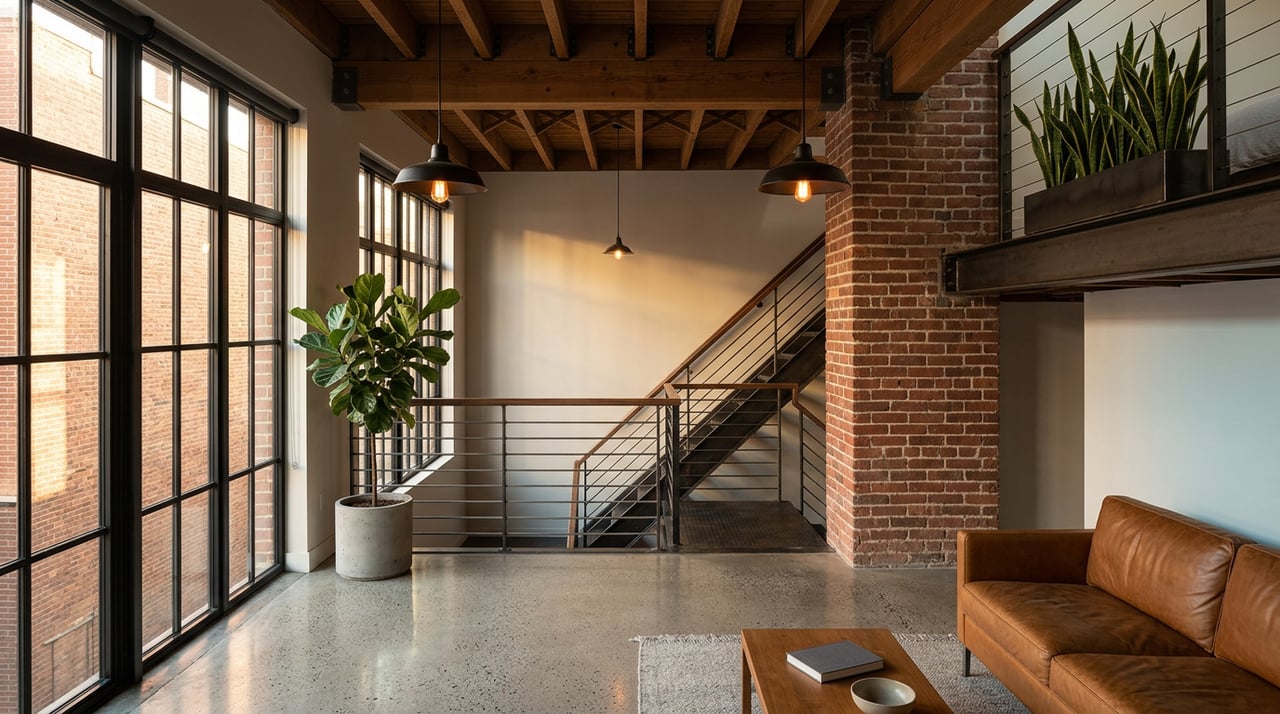
In Scott's Addition, that's Hook & Ladder Lofts, a converted early-1900s Baker Equipment building, once a fire engine factory, now home to a run of loft-style condos with the ceiling height and exposed timber to prove it. It's also Mason Yards, a small-format new construction community with garages and resort-style amenities that represents nearly the only new-build condo product actually reaching the for-sale market in the neighborhood right now, rather than the rental market.
In Manchester, it's Old Manchester Lofts, an 1895 former bakery building converted into condos with rooftop river views, and a scattering of rowhouse resales and small-scale conversions, including an 8-unit apartment-to-condominium conversion that's been slowly working through its unit count. Houses in Scott's Addition are moving in about 35 days on average as of July 2026, faster than the national average of 57. That's not a market with room to browse. It's a market where the short list of options moves quickly once it appears.
What the Scarcity Is Doing to Price
Here's where the mismatch shows up in dollars. As of July 2026, Manchester had posted roughly 7% year-over-year price appreciation, among the fastest of any Richmond neighborhood, and Scott's Addition's median sale price had climbed to roughly $498,830, up around 6% over the past year. Analysts have noted that Scott's Addition's growth is notable precisely because it's one of the few Richmond submarkets getting meaningful new supply. But that supply, as the numbers above make clear, isn't the supply that would take pressure off a buyer. It's supply for a renter, or in Scott's Addition's case, increasingly for a hotel guest.
A handful of for-sale homes competing against strong household demand from a fast-growing renter base produces exactly the price behavior these two neighborhoods are showing: appreciation that outpaces most of the rest of the city, even while overall construction activity outpaces most of the rest of the city too. Those two facts look contradictory until you separate who each type of construction is actually built for.
What This Means If You're Actually Trying to Buy Here
If Manchester or Scott's Addition is on your shortlist, the practical takeaway is to stop reading crane counts as a signal that more houses are coming for you specifically. They're not, at least not on any near-term timeline. The for-sale opportunities that exist are concentrated in loft conversions, older rowhouses, and the occasional small-batch new construction like Mason Yards, and they move fast when they list.
If you want proximity to either neighborhood without competing for that thin slice of inventory, it's worth widening the search a few blocks. South Richmond's Blackwell and Swansboro neighborhoods, just south of Manchester's Hull Street corridor, still carry older bungalow stock at lower price points, and they sit close enough to walk to the same restaurants and riverfront trail that draw people to Manchester in the first place.
FAQ
Will Scott's Addition or Manchester get more condos for sale soon? Some. Mason Yards in Scott's Addition and small conversion projects in Manchester are adding units, but nothing on the scale of the apartment and hotel construction underway in both neighborhoods. Expect the for-sale count to grow slowly, not to catch up to the rental pipeline anytime soon.
Does all this apartment construction put downward pressure on nearby home values? Not based on current data. The overbuilding concern analysts have raised applies to the rental segment, where multiple large projects are delivering at once. The for-sale market in both neighborhoods has moved the opposite direction, with price growth outpacing much of the rest of the city.
Is Manchester or Scott's Addition the better bet for a buyer right now? It depends more on what kind of for-sale property you're chasing than on the neighborhood itself. Scott's Addition currently has more condo options in its thin inventory. Manchester's stock leans more toward loft conversions and rowhouse resales. Neither offers much room to shop around, so knowing your price range and moving quickly when something matching it appears matters more than which side of the river you land on.
Manchester and Scott's Addition aren't short on momentum. They're short on the one thing a buyer actually needs, which is a house with a for-sale sign in front of it. If you're trying to find that short list before it moves again, Josh Harris can walk you through what's actually available in either neighborhood right now, not just what's under construction around it.